When Repair Stops Being the Answer
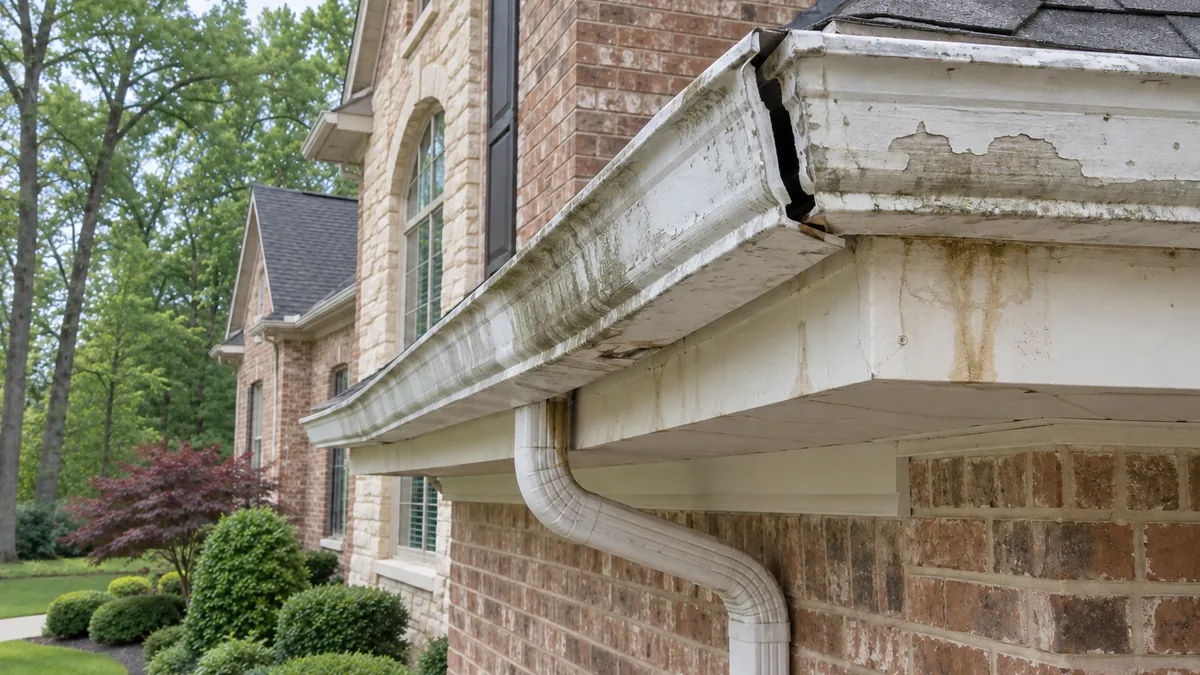
Gutters in central Indiana fail on a schedule the climate writes. Each winter delivers dozens of freeze-thaw cycles; each cycle expands trapped water by roughly 9 percent, prying at seams and working hangers loose. A system twenty or more winters in shows the record: corners that reopen after every reseal, fascia staining behind the gutter, runs that visibly dip between brackets, and overflow in spring downpours even when the trough is clean.
At that stage, the repair-versus-replace math turns decisively. Resealing three failing joints buys a season; the fourth and fifth joints are already aging on the same clock. Replacement resets the entire system — new metal, new hangers at freeze-rated spacing, correct pitch, and downspout capacity matched to today's storm intensity rather than the standards of the year the house was built.
Replacement is also the moment to correct the original installation's compromises. Many Hamilton County homes built in the 1990s and 2000s carry builder-grade systems with minimum-count downspouts and hangers spaced too widely for Indiana ice loads — adequate on install day, chronically overworked since.
What Full Replacement Includes
Every replacement begins with tear-off — the old system comes down completely, and the fascia behind it gets its first inspection in decades. Sections softened by years of slow leaks are flagged and addressed before new hardware goes in; mounting a new gutter on compromised wood is how a January ice load ends up in the flower beds.
New runs are fabricated seamless on-site from heavy .032-gauge aluminum — one continuous length per fascia line, with no mid-run joints for freeze-thaw to attack. Hidden hangers anchor into sound wood at 24-inch spacing, the heavy-duty standard for Climate Zone 5 ice loading. Pitch is set at roughly a quarter inch per ten feet toward each outlet, and downspouts are sized and placed for the roof area they serve — oversized 3x4 profiles on the large rear planes common to Carmel's two-story stock.
Material options run from the aluminum baseline through half-round profiles suited to the Colonial Revival and Tudor architecture of Carmel's established neighborhoods, up to copper for the estate properties where a 50-year system matches the home's caliber. Typical installed ranges: seamless aluminum $6 to $10 per linear foot, K-style $8 to $20, half-round $7 to $35, copper $25 to $45. A written on-site estimate makes the number exact for the specific roofline.
One Written Quote, Measured On-Site
Roofline measured, fascia checked, downspout routing planned — and a line-item replacement price before the technician leaves. Free, with no obligation.
Call Now — (317) 353-3563Timing Replacement Around Indiana's Calendar
The working season favors late spring through fall: dry days speed installation, and a new system gets proven against summer thunderstorms before facing its first freeze. The strategic deadline is November — a system replaced before the first hard freeze enters winter with sealed corners, fresh hangers, and full capacity, while a failing system carried into December faces its most punishing months at its weakest.
Replacement pairs naturally with two add-ons that cost less done together than separately: micro-mesh gutter guards installed while the crew is already staged, and underground downspout extensions trenched before landscaping beds are re-edged for the season. Homes under the mature canopies of Village of WestClay, Jackson’s Grant, and Bridlebourne see the strongest case for the guard pairing — new metal deserves to stay clean.
Frequently Asked Questions
Common questions about full gutter replacement in Carmel and Hamilton County.
Ready to Stop Patching and Start Over Right?
Free on-site replacement assessments for Carmel, Fishers, Westfield, Noblesville, and throughout Hamilton County.
Call For a Free Estimate