Hamilton County's Gutter Experts

Gutter Guard Installation

Professional gutter guard systems reduce seasonal maintenance, prevent freeze-thaw blockages, and protect Hamilton County homes from Indiana's relentless hardwood debris cycle. Multiple guard types are available to match every budget and property.

Call anytime

Why Gutter Guards Matter in Indiana

Central Indiana is 97 percent hardwood forest, and Carmel sits squarely in the middle of it. Mature oaks, sugar maples, and sycamores line the Monon Greenway, shade the established lots in Home Place and Springmill, and drop an extraordinary volume of debris from April through November. Large leaves are only part of the problem. Spring brings helicopter seeds from maples and drifts of cottonwood cotton. Summer produces seed pods and small twig litter from storm damage. Fall delivers the main event — weeks of heavy leaf drop that can fill an unprotected gutter system in days.

Pine needles from ornamental plantings throughout newer Carmel subdivisions add a year-round debris source that standard cleaning schedules miss. Without gutter guards, most Hamilton County properties require professional cleaning two to three times per year at $150 to $191 per visit. A quality guard system reduces that frequency to a single annual visual inspection — a significant long-term savings for two-story homes where cleaning costs run higher due to equipment and access requirements.

The National Weather Service Indianapolis office records an average of 42 inches of annual rainfall for the region, with the heaviest storms concentrated in spring and early summer. Gutters clogged with debris during peak rain season overflow, directing water against foundations, saturating landscaping beds, and accelerating fascia rot. Guards keep the drainage channel clear when it matters most.
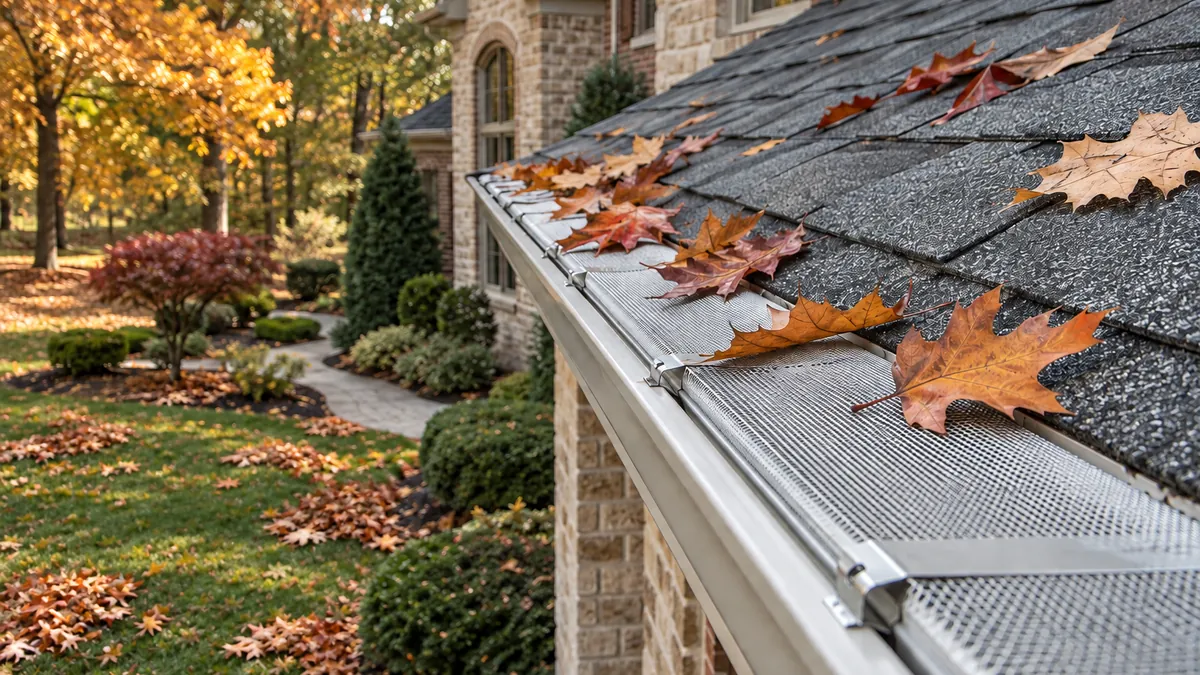
Gutter guard system protecting a Carmel home from leaf debris

Carmel's Debris Challenge

  • Heavy hardwood leaf drop from oaks, maples, and sycamores — April through November
  • Maple helicopter seeds and cottonwood cotton clog standard screens in spring
  • Pine needles from ornamental plantings create year-round accumulation
  • Spring seed pods pass through basic mesh and decompose inside gutters
  • 42 inches of annual rainfall demands clear drainage channels
  • Guards reduce cleaning from 2-3x/year to annual inspection only

Types of Gutter Guards

An honest comparison of the five most common gutter guard systems, evaluated for performance in Indiana's freeze-thaw climate and heavy hardwood debris environment.

Reverse Curve

Solid cover with a curved nose that directs water into the gutter while leaves slide off the edge. Relies on surface tension to separate water from debris.

  • Effective against large leaves and twigs
  • Durable aluminum or steel construction
  • Visible from ground level — easy to monitor
  • Heavy rain can overshoot the curve entirely
  • Small debris and pine needles follow the water inside
  • Can create ice shelf issues in winter
$8 – $15/LF installed

Screen / Basic Mesh

Perforated aluminum or plastic screens that snap onto or slide into the gutter lip. The most common entry-level guard option available at hardware stores.

  • Lowest cost guard option available
  • Easy DIY installation on most gutter profiles
  • Blocks large leaves effectively
  • Pine needles, seeds, and shingle grit pass through
  • Plastic versions degrade in UV exposure within 3-5 years
  • Debris accumulates on top, requiring periodic clearing
$2 – $6/LF installed

Foam Insert

Triangular polyurethane foam wedges that sit inside the gutter channel, allowing water to filter through while blocking debris on top.

  • Very affordable — lowest material cost
  • No tools required for installation
  • Fits inside existing gutters without modification
  • Seeds and fine debris embed in the foam over time
  • Retains moisture — can promote mold and algae growth
  • Shortest lifespan: 2-4 years before replacement
  • Poor freeze-thaw performance — trapped water expands inside foam
$2 – $4/LF

Brush Guard

Cylindrical bristle inserts that sit inside the gutter channel. Bristles catch debris on top while water flows through to the channel below.

  • Simple drop-in installation, no fasteners needed
  • Moderate cost with decent large-debris blocking
  • Does not affect roof warranty
  • Small leaves, needles, and seeds lodge between bristles
  • Requires periodic removal to clean accumulated debris
  • Bristles can trap ice in winter, adding weight to gutters
$3 – $7/LF

For properties under heavy hardwood canopy in freeze-thaw regions like Hamilton County, micro-mesh guards deliver the strongest long-term value. The higher upfront cost is offset by dramatically lower maintenance requirements and superior winter performance compared to all other guard types.

Guard Performance in Winter

Hamilton County typically experiences 20 to 30 freeze-thaw cycles per winter, with temperatures crossing 32 degrees multiple times per week between November and March. How a gutter guard interacts with ice and snow is often the deciding factor in which system performs best over time.

The fundamental issue is trapped debris. Any debris that enters the gutter channel — pine needles through a screen, seeds embedded in foam, leaves caught in brush bristles — becomes a sponge that holds water. When temperatures drop below freezing, that trapped water expands by approximately 9 percent, forming ice that progressively enlarges cracks, separates seams, and adds hundreds of pounds of dead weight to the gutter run. Guards that prevent debris from entering the channel in the first place eliminate this problem at the source.

Micro-mesh guards outperform all other types in freeze-thaw conditions because nothing enters the gutter channel. Water passes through the mesh cleanly, and any surface debris that collects on top of the guard dries and blows off between storm events. Reverse curve guards can create an ice shelf where water freezes along the curved nose, eventually blocking the entry slot entirely. Foam inserts are the weakest winter performers — the foam itself retains water that freezes internally, destroying the foam structure and adding ice weight inside the gutter.

For properties with persistent ice dam issues, heated cable systems can be installed beneath gutter guards to maintain above-freezing temperatures in the gutter channel. The NWS Indianapolis climate data shows the region averages 22 inches of annual snowfall, with January temperatures regularly dropping into the teens. Heated guards represent the premium tier of gutter protection for Hamilton County homes.

Freeze-Thaw Performance by Type

  • Micro-mesh: Excellent — no debris enters channel; minimal ice formation risk
  • Reverse curve: Fair — ice shelf forms on curved nose; entry slot can freeze shut
  • Screen/mesh: Moderate — fine debris passes through and traps water that freezes
  • Brush: Poor — bristles trap debris and moisture that freeze between bristles
  • Foam insert: Poor — foam retains water that expands when frozen, destroying the insert
  • Heated cable add-on: Best possible protection when paired with micro-mesh guards

Gutter Guard Pricing Guide

Approximate pricing for gutter guard systems in the Hamilton County area. All estimates include materials and professional installation unless noted.

Guard Type / Service Price Range Notes
Micro-Mesh Guards $15 – $30/LF Premium option; best for freeze-thaw and fine debris
Reverse Curve Guards $8 – $15/LF Effective for large leaves; limited in heavy rain
Screen / Basic Mesh Guards $2 – $6/LF Entry-level; blocks large debris only
Foam Insert Guards $2 – $4/LF Lowest cost; 2-4 year replacement cycle
Heated Cable Add-On $3 – $8/LF Self-regulating heat cable beneath guards; prevents ice
Professional Installation Labor $4 – $10/LF Varies by building height and roof access; two-story homes higher
Full System with New Gutters $20 – $40/LF Seamless aluminum gutters + micro-mesh guards + installation
Typical Carmel Home (150-250 LF) $2,250 – $7,500 Micro-mesh system; most common project scope

Pricing is approximate and varies by guard type, building height, gutter condition, and home style. Carmel's predominantly two-story homes typically see higher labor costs due to additional height and equipment requirements. Contact Carmel Pro Gutters for a detailed, no-obligation estimate.

Ready to stop cleaning gutters?

Free gutter guard estimates for all Hamilton County properties — Carmel, Fishers, Westfield, and beyond.

(317) 353-3563 Call For Free Estimate

Gutter Guard FAQ

Gutter guards perform well in Indiana winters when the right type is selected. Micro-mesh guards are the strongest option for freeze-thaw regions because the fine screen prevents debris accumulation that traps water and leads to ice formation inside the gutter channel. Reverse curve and screen guards can allow fine debris and shingle grit to enter, which freezes into a solid mass during cold snaps. No guard eliminates ice entirely — properties with persistent ice dam issues may benefit from adding heated cables beneath the guard system. Hamilton County typically experiences 20 to 30 freeze-thaw cycles per winter, making guard selection particularly important.

Micro-mesh gutter guards are the best option for heavy leaf fall. The fine stainless steel mesh blocks not only large leaves from oaks, maples, and sycamores but also the smaller debris that defeats basic screen guards — cottonwood seeds, honeylocust leaflets, pine needles from ornamental plantings, and spring seed pods. Properties in established Carmel neighborhoods like Home Place, Springmill, and along the Monon Greenway corridor sit under dense hardwood canopies that produce extraordinary debris volumes from April through November. Micro-mesh guards reduce cleaning frequency from two to three times per year down to an annual visual inspection.

Gutter guard costs vary widely by type. Basic screen guards run $2 to $6 per linear foot installed. Foam inserts cost $2 to $4 per linear foot. Reverse curve systems range from $8 to $15 per linear foot. Micro-mesh guards — the premium option recommended for Indiana's climate — cost $15 to $30 per linear foot installed. Most Carmel homes require 150 to 250 linear feet of gutter coverage, placing total project costs between $300 and $7,500 depending on the system selected. Adding heated cables for ice protection adds $3 to $8 per linear foot. The City of Carmel Urban Forestry division maintains information about the tree species that define Hamilton County's canopy — and the debris loads they create.

No gutter guard system eliminates maintenance entirely. Even premium micro-mesh guards require an annual inspection to clear fine pollen residue, shingle grit, and any debris that accumulates on top of the mesh surface. However, guards dramatically reduce maintenance burden. Properties that previously required two to three professional cleanings per year at $150 to $191 per visit can typically shift to a single annual inspection. Over a 10-year period, the reduction in cleaning costs often offsets a significant portion of the initial guard investment, particularly for two-story homes where cleaning costs run higher.

Most gutter guard systems install directly onto existing gutters without requiring replacement. Screen guards, foam inserts, and brush guards simply fit inside or clip onto the existing gutter channel. Micro-mesh systems attach to the front lip and slide under the first row of shingles or fasten to the fascia board. Reverse curve guards require mounting brackets along the roofline. The main exception is when existing gutters are damaged, sagging, or improperly pitched — guards installed on compromised gutters will not perform correctly and can actually trap water against the fascia. A professional assessment before installation determines whether the existing system can support guards.

Some gutter guard installation methods can affect roof warranty coverage. Guards that require lifting or removing shingles to slide mounting brackets underneath may void the shingle manufacturer's warranty if the installation damages the shingle seal strip. Guards that attach exclusively to the gutter lip and fascia board — without disturbing the roofing material — generally do not affect warranty coverage. Before scheduling gutter guard installation, homeowners should review the specific warranty terms from the shingle manufacturer. Most reputable guard installation crews offer fascia-mount options that avoid any contact with the roofing system.

Stop Cleaning Gutters. Start Protecting Them.

Free gutter guard estimates, transparent pricing, and professional installation for every community in Hamilton County. Call today to schedule an assessment.

Call For Free Estimate
Call Now: (317) 353-3563