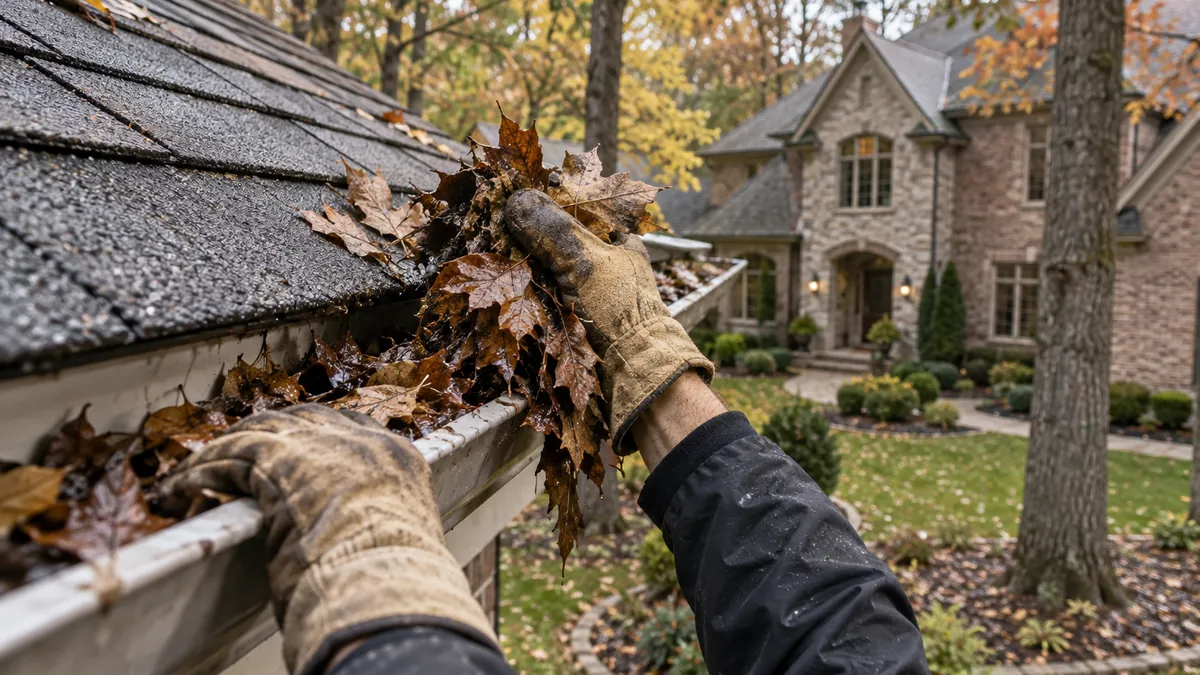
Hamilton County sits in the heart of Indiana's hardwood belt, and Carmel's neighborhoods reflect it. The Arts & Design District is lined with mature red oaks. Sugar maples and tulip poplars shade the Monon Greenway corridor. Home Place, one of the city's oldest neighborhoods, is thick with American sycamores whose broad leaves and bark sheds can clog a gutter run in a single storm. These are not ornamental plantings that produce a light dusting of debris. They are full-canopy hardwoods that generate measurable tonnage of organic material every season.
Spring brings the first wave. Maple samaras, those distinctive helicopter seeds, pile up in gutter troughs by mid-April. Cottonwood cotton follows in May, forming a dense mat that traps moisture against aluminum and can seed mold growth within days. By late May, oak catkins and pollen create a sticky residue that bonds to gutter surfaces and resists simple rinsing.
Fall delivers the heaviest load. Pin oaks hold their leaves well into November, often dropping the bulk of their foliage after most other species have finished. Sweetgum seed balls, dense and spiky, lodge in downspout openings. Sycamore bark flakes join the mix, creating a layered debris mass that compacts when wet and hardens when dry.
The stakes rise sharply once temperatures drop. Central Indiana averages dozens of freeze-thaw cycles between November and March, with temperatures crossing 32 degrees multiple times per week. Water trapped behind debris blockages expands when it freezes, splitting seams, cracking end caps, and forcing ice up under roof shingles. Hamilton County receives approximately 42 to 43 inches of annual precipitation, meaning gutters on a typical Carmel home are responsible for channeling several thousand gallons of water away from the foundation each year. When those gutters are clogged, that water has nowhere to go except into the soil against the foundation wall, where it creates hydrostatic pressure, encourages settling, and invites basement moisture intrusion.
Pre-winter cleaning is not optional maintenance in this climate. It is the single most effective step a homeowner can take to protect gutter systems, rooflines, and foundations from Indiana's most destructive weather pattern.