Central Indiana's freeze-thaw cycling demands gutter systems built to handle extreme stress. Seamless aluminum fabricated on-site delivers leak-free performance through every winter, protecting Carmel homes from ice damage, fascia rot, and foundation erosion.
Central Indiana sits in IECC Climate Zone 5, where winter temperatures cross the 32°F freezing threshold multiple times per week between November and March. Each crossing triggers a freeze-thaw cycle that places extraordinary mechanical stress on gutter systems. Water expands approximately 9% when it freezes, and ice-filled gutters can weigh hundreds of pounds per section — far more than most factory-installed or DIY-mounted systems are engineered to support.
Improperly installed gutters fail under these loads in predictable ways. Hangers pull away from fascia boards. Seams split at joints. Gutters sag between attachment points, creating standing water pools that accelerate corrosion and ice formation. The fascia itself absorbs moisture from failing connections, leading to wood rot that compromises the structural attachment surface for the entire system.
Professional installation addresses every point of failure before it develops. Correct hanger spacing distributes ice loads evenly. Seamless fabrication eliminates the joints where leaks begin. Proper slope angles ensure water drains completely, leaving no standing water to freeze and expand. The difference between a gutter system that lasts 5 years and one that lasts 25 years comes down to how it was installed.
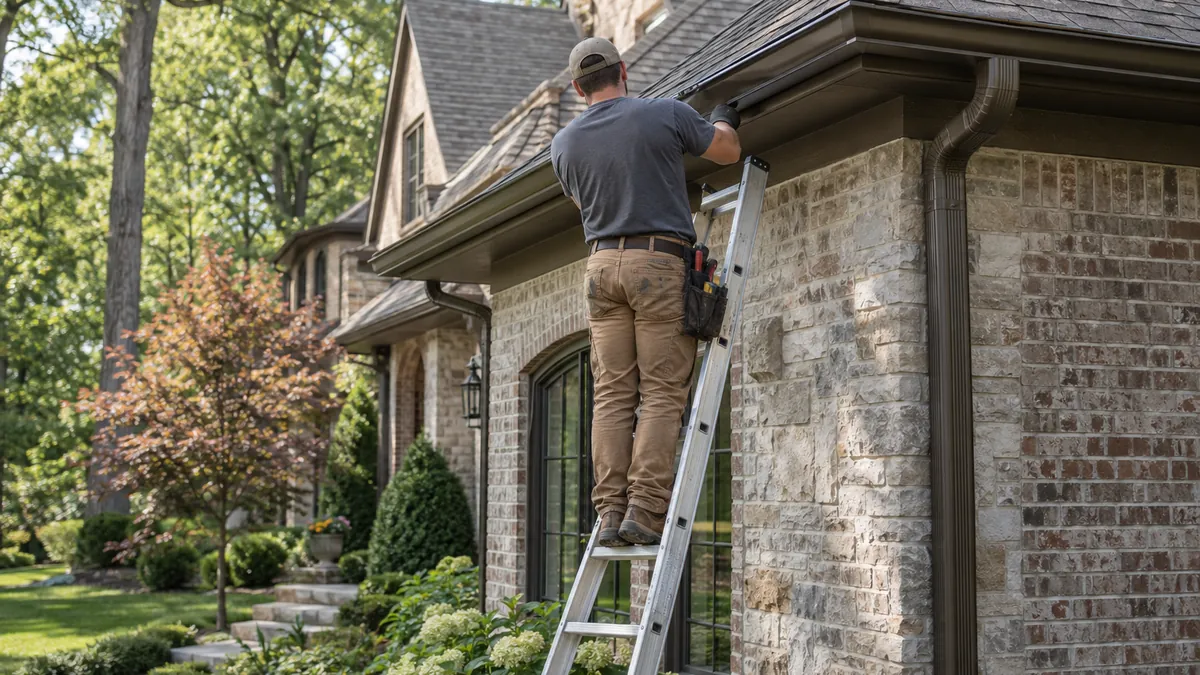
Gutter material selection in central Indiana should be driven by freeze-thaw resilience, not just price. Each material responds differently to the repeated thermal cycling that defines Hamilton County winters.
The standard for residential properties across the Indianapolis metro. Aluminum handles freeze-thaw cycling without cracking, resists corrosion from road salt splash, and maintains structural integrity under ice loads. Seamless fabrication on-site eliminates leak-prone joints. Available in 5-inch and 6-inch K-style profiles with dozens of color options.
Lifespan: 20–30 years with proper maintenance.
A premium material that develops a distinctive patina over time. Copper delivers exceptional longevity and handles freeze-thaw stress without the fatigue cracking that affects lesser metals. Ideal for historic homes and high-end properties in neighborhoods like the Carmel Arts & Design District. Requires soldered joints rather than seamless fabrication.
Lifespan: 50–80 years.
Offers superior structural strength for commercial applications and homes with unusually large roof areas. Steel handles extreme ice loads better than aluminum but is heavier and more labor-intensive to install. The zinc coating resists corrosion, though it will eventually wear in areas exposed to standing water.
Lifespan: 20–25 years.
Vinyl gutters are not recommended for IECC Climate Zone 5. Repeated freezing makes vinyl brittle within 3 to 5 years, leading to cracks, splits, and catastrophic failures during ice events. The material also expands and contracts more than metal with temperature swings, loosening connections at joints and endcaps over time.
Lifespan in Indiana: 3–7 years before significant failure.
A thorough inspection of the existing roofline, fascia condition, and drainage patterns — at no cost and with no obligation.
Call Now — (317) 353-3563Every gutter installation follows a structured sequence designed to produce a system that performs reliably through central Indiana's demanding climate. Cutting corners at any step introduces failure points that become expensive problems within a few seasons.
The existing roofline, fascia boards, soffit, and drainage patterns are evaluated. Any rot, damage, or structural concerns are documented. The property's specific drainage challenges — slope, landscaping, foundation grade — inform the system design.
Every gutter run is measured individually. Slope angles are calculated to ensure proper water flow toward downspout locations. Corners, miters, and end caps are mapped for custom fabrication. Nothing is estimated — every dimension is recorded to the nearest eighth of an inch.
Seamless gutters are roll-formed on-site from continuous aluminum coil stock using a portable forming machine. Each gutter section is fabricated to the exact length needed, eliminating the splices and joints that create leak points in sectional systems.
Hidden hanger brackets are installed at 18 to 24-inch intervals — tighter spacing than the 36-inch standard used in milder climates. This closer spacing is critical for Indiana's ice loads, distributing the weight of frozen gutters across more attachment points to prevent sagging and fascia pull-away.
Downspouts are connected at calculated intervals to handle peak water volume from Indiana's heavy spring and summer storms. All connections, end caps, and mitered corners are sealed with industrial gutter sealant rated for below-zero temperatures.
The completed system is tested with water to verify proper flow, confirm slope angles, and check every connection point for leaks. Downspout discharge is evaluated to ensure water is directed away from the foundation. Any adjustments are made before the crew leaves the property.
| Material / Service | Price Range | Notes |
|---|---|---|
| Seamless Aluminum (5") | $5.50 – $10 / LF | Most popular choice; ~$8/LF average in Hamilton County |
| Seamless Aluminum (6") | $7 – $13 / LF | Recommended for large roof areas and steep pitches |
| Galvanized Steel | $11 – $33 / LF | Superior ice-load capacity; heavier installation |
| Copper | $25 – $50 / LF | Premium option; 50–80 year lifespan; soldered joints |
| Full Replacement (w/ teardown) | $10 – $15 / LF | Includes removal of existing system and haul-away |
| Fascia Board Repair | $6 – $20 / LF | Often necessary before new installation; rot from ice damage |
| Downspout Installation | $5 – $12 / LF | Aluminum standard; includes mounting hardware |
| Gutter Guards (add-on) | $7 – $20 / LF | Micro-mesh recommended for leaf-heavy Indiana lots |
A typical whole-house aluminum gutter installation in the Carmel area runs $825 to $2,000 for a standard single-story home. Two-story homes and properties with complex rooflines fall in the $1,500 to $3,500 range. These figures include materials, labor, and standard cleanup.
Common questions about gutter installation for Carmel and Hamilton County properties.
For more information about central Indiana weather patterns and climate data, visit the National Weather Service Indianapolis office. Homeowners with questions about contractor protections can consult the Indiana Attorney General's Consumer Protection Division.
Free on-site assessments for residential properties in Carmel, Fishers, Westfield, Noblesville, and throughout Hamilton County.
Call For a Free Estimate