Hamilton County's Gutter Experts

Expert Gutter Repair Services

Central Indiana's relentless freeze-thaw cycling cracks seams, loosens hangers, and pulls entire gutter runs off the fascia. Professional repair restores drainage before minor damage cascades into costly fascia rot and foundation problems.

Call anytime

Common Gutter Problems in Central Indiana

Hamilton County's 22 to 25 inches of annual snowfall and frequent temperature swings across 32°F create repair demands that differ from milder climates. These are the most common failures.
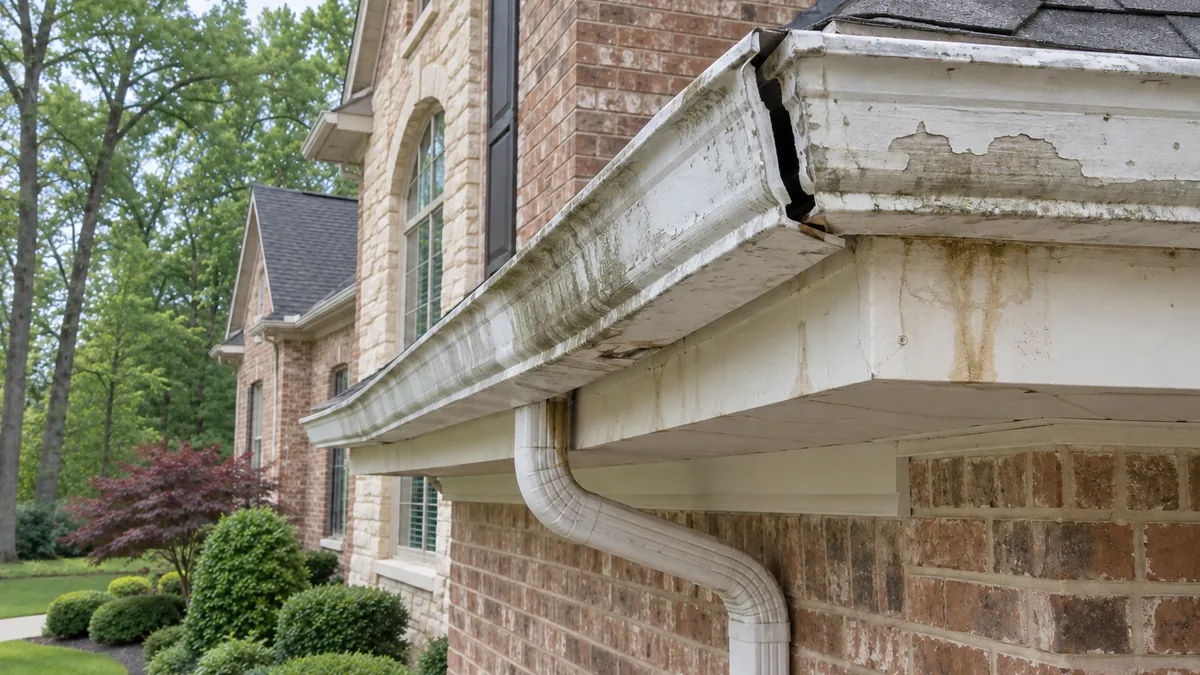
Gutter repair work on a home in Hamilton County, Indiana

Freeze-Thaw Cracking

Water trapped in gutter channels expands approximately 9 percent when it freezes, progressively enlarging cracks at seams and joints with each cycle. Central Indiana averages dozens of freeze-thaw cycles per winter.

Ice Dam Damage

Heat escaping through under-insulated attics melts roof snow, which refreezes at the eaves and backs water under shingles. The resulting ice mass presses against gutter channels and can bend or crush sections entirely.

Sagging from Ice Weight

Ice-filled gutter sections can weigh hundreds of pounds per span, far exceeding the design load of standard hangers spaced at 36 inches. The excess weight bows gutter channels and bends mounting brackets permanently. Homes in IECC Climate Zone 5 face this loading repeatedly each winter.

Separated Seams

Sectional gutters rely on sealant and mechanical fasteners at every joint. Repeated freeze-thaw expansion weakens both, allowing seams to open and water to pour through at connection points rather than flowing to downspouts.

Fascia Rot

When gutters pull away from the roofline or leak at the back edge, water runs behind the channel and saturates the fascia board. In Indiana's humid summers, saturated wood develops rot within a single season if not addressed.

Downspout Disconnection

Ground-level ice formation and frost heave can push downspout extensions out of alignment. Disconnected downspouts dump concentrated water directly against the foundation, increasing basement moisture risk significantly.

Spotted gutter damage? Call for a free assessment.

No obligation — professional inspections available for all Hamilton County properties.

(317) 353-3563 Call For Free Estimate

Signs Gutter Repair Is Needed

Gutter damage does not always announce itself with a dramatic failure. More often, the first signs are subtle: a water stain on the siding, a patch of eroded mulch beneath a corner, or a faint musty smell in the basement after heavy rain. By the time a homeowner notices sagging sections or water pouring over the edge during a storm, the underlying damage has typically been progressing for months.

The Indianapolis metro area's combination of heavy spring rainfall (42 inches annually), dense hardwood debris from Indiana's 97 percent deciduous forests, and winter freeze-thaw stress means gutter systems face year-round degradation pressure. According to NWS Indianapolis climate data, central Indiana's heaviest rainfall concentrates between April and June — the same period when accumulated winter damage first becomes apparent during sustained downpours.

Catching problems early is the most cost-effective maintenance strategy. A separated seam that costs $75 to reseal today can develop into fascia rot requiring $500 or more in wood replacement if left unaddressed through a single rain season. The checklist here covers the most reliable indicators that a professional inspection should be scheduled.

Visual Inspection Checklist

  • Water overflow during rain — gutters spilling over the edge rather than channeling to downspouts
  • Peeling paint near the foundation — indicates water is splashing against the lower exterior wall consistently
  • Sagging or pulling-away sections — visible gaps between gutter channel and fascia board
  • Visible rust, cracks, or holes — corrosion spots or mechanical damage from freeze-thaw expansion
  • Basement moisture or dampness — standing water or humidity spikes after storms may indicate failed gutter drainage
  • Landscape erosion below gutters — trenching or mulch displacement from concentrated water dumping

Repair vs. Replacement

Targeted repair can extend a gutter system's life by years at a fraction of full replacement cost — but only when the underlying structure remains sound. Here is how to evaluate the right approach.

When Repair Makes Sense

Repair is the cost-effective choice when damage is localized and the overall gutter material remains structurally intact.

  • Isolated seam separations at one or two joints
  • Individual hanger or bracket failure (sagging at a single point)
  • Minor dents or bends that do not affect water flow
  • Small holes or pinhole corrosion in an otherwise sound section
  • Downspout reconnection or reattachment to the gutter outlet
  • Sealant failure at end caps or miters

When Replacement Is Better

Full replacement delivers better long-term value when cumulative damage has compromised the system beyond practical repair.

  • More than 30 percent of the gutter run shows visible damage
  • Structural warping along the channel length from repeated ice loading
  • Multiple overlapping patch areas from previous repairs
  • Widespread corrosion or aluminum fatigue across multiple sections
  • Fascia board rot that requires board replacement before rehanging
  • Original builder-grade system with underrated hangers for Indiana climate

As a general benchmark, targeted repair costs 20 to 40 percent of full replacement for the same linear footage. However, stacking multiple repairs on a deteriorating system eventually exceeds the cost of a single seamless replacement — and each patched seam creates an additional future failure point in Indiana's freeze-thaw environment. Homeowners evaluating contractor proposals should verify compliance with the Indiana Attorney General's consumer protection guidelines and request written HICA-compliant contracts before authorizing any work.

Gutter Repair Pricing for Hamilton County

Current repair pricing ranges based on central Indiana market data. All estimates are free with no obligation.

Repair Type Price Range Notes
Seam Resealing $75 – $150 Per joint; most common freeze-thaw repair
Section Replacement $150 – $350 Per section; includes color-matched aluminum
Hanger / Bracket Replacement $100 – $250 Upgrade to heavy-duty hidden hangers at 24" spacing recommended
Downspout Reattachment $75 – $200 Includes outlet seal and elbow realignment
Fascia Board Repair $200 – $500 Per affected area; rot removal and primed board replacement
End Cap & Miter Resealing $50 – $125 Per corner or end cap; prevents back-edge leaking
Full Gutter Replacement $6 – $12/LF Seamless aluminum with heavy-duty hangers; 150-250 LF typical
Emergency Repair $200 – $600 24-48 hour response; storm damage and active leaks

Early repair prevents expensive replacement.

Free estimates for all Hamilton County properties — Carmel, Fishers, Westfield, and beyond.

(317) 353-3563 Call For Free Estimate

Gutter Repair FAQ

Gutter repair costs in the Indianapolis metro area vary by the scope of damage. Seam resealing typically runs $75 to $150, individual section replacement costs $150 to $350 per section, and hanger or bracket replacement ranges from $100 to $250. Fascia board repair accompanying gutter work adds $200 to $500 depending on the extent of wood rot. Emergency repairs after storm damage may carry a premium. Most standard gutter repairs for Hamilton County homes fall between $150 and $500 total. A professional inspection can determine whether targeted repair or full replacement offers better long-term value.

Whether ice-damaged gutters can be repaired depends on the extent and type of damage. Minor issues like separated seams, loosened hangers, and small dents from ice weight are typically repairable at a fraction of replacement cost. However, gutters that have been pulled away from the fascia board, show structural warping along their length, or have multiple cracked sections across a single run often require full replacement. As a general rule, if more than 30 percent of a gutter run shows damage, replacement with seamless aluminum provides better long-term value than patching multiple sections.

Emergency gutter repair for active leaks, storm damage, or detached sections causing water intrusion can typically be scheduled within 24 to 48 hours for Hamilton County properties. After severe weather events that cause widespread damage across central Indiana, response times may extend slightly due to high demand. Homeowners dealing with active water intrusion should place a bucket or tarp to divert water away from the foundation and call immediately. Temporary fixes like gutter sealant tape can provide short-term relief until a professional repair crew arrives.

Gutter seam separation in Indiana is primarily driven by freeze-thaw cycling. When water trapped in gutter channels freezes, it expands by approximately 9 percent, placing outward pressure on joints and seams. Central Indiana winters produce dozens of freeze-thaw cycles where temperatures cross 32 degrees Fahrenheit multiple times per week. Each cycle enlarges microscopic gaps at seam connections. Over several winters, this cumulative expansion progressively weakens sealant and loosens mechanical fasteners until seams fully separate. Seamless gutters eliminate most seam joints entirely, which is why they are the preferred system for Indiana's climate.

Patching makes sense for isolated damage — a single cracked seam, a localized dent, or one failed hanger. A patch repair costs significantly less than section replacement and can restore full function if the surrounding gutter material remains structurally sound. However, if the aluminum shows widespread corrosion, has been bent out of profile by ice weight, or if patches would need to overlap existing repair areas, full section replacement is the more reliable and cost-effective approach. Overlapping patches create additional seam points that become future failure sites in Indiana's freeze-thaw environment.

Gutters in central Indiana should be inspected at least twice per year: once in early spring after the final freeze and once in late fall after leaf drop. Spring inspections catch freeze-thaw damage from winter — separated seams, loosened hangers, and ice-related warping — before the heavy spring rain season begins in April. Fall inspections verify that gutters are clear and structurally sound before winter loading begins. Additional inspections are recommended after any severe weather event that includes high winds, heavy hail, or significant ice accumulation. Catching damage early prevents cascading problems to fascia, soffit, and foundation systems.

Stop Small Damage Before It Becomes a Big Problem

Free inspections, transparent repair pricing, and emergency service available for every community in Hamilton County. Call today to schedule a professional gutter assessment.

Call For Free Estimate
Call Now: (317) 353-3563